“How we spend our days is, of course, how we spend our lives.”
Annie Dillard, The Writing Life
PROSOCHĒ
ThoughtThe PauseAction
Intentional Attention.
A free iPhone shortcut for iOS 26 or later. The setup steps are further down this page.
My intention wasn't to open Instagram for the third time in twenty minutes.
Third open.
Twenty minutes.
PROSOCHĒ asks
What are you reaching for?
PROSOCHĒ is a free iPhone shortcut that puts a pause between you and the apps you choose. You choose the apps. Each time you open one, it looks at how often and how quickly you have been coming back, and responds in proportion.
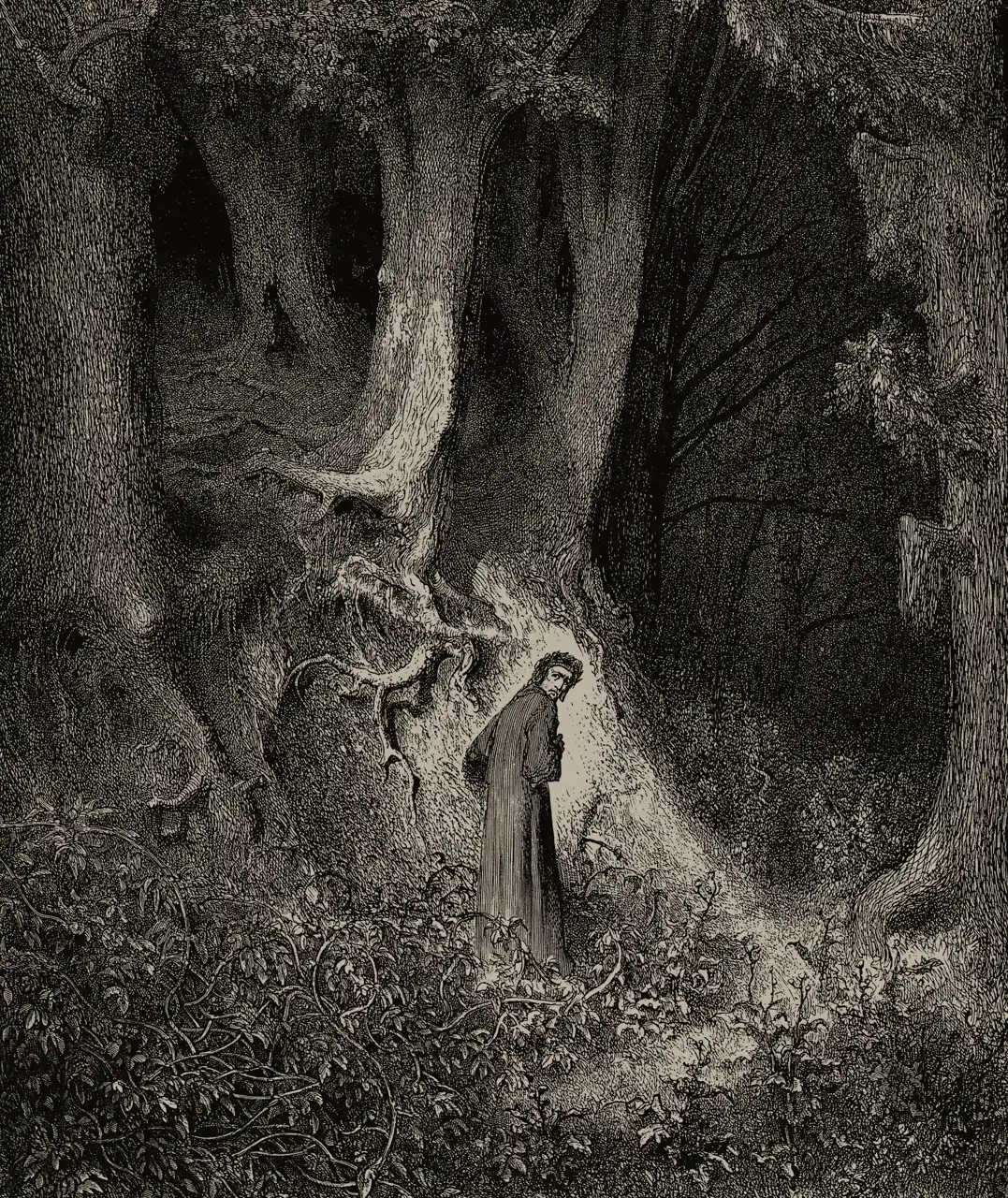
The Nine Circles
Create a pause between thought and unconscious action to live intentionally.
The more automatically you come back, the deeper it goes. Most opens never leave the top.
- 0The IndifferentNothing at all
- ILimboA pause
- IILustColour drains
- IIIGluttonySilence
- IVGreedA question
- VWrathThe mirror
- VIHeresyRedirected
- VIIViolenceSent home
- VIIIFraudSpoken aloud
- IXTreacheryFrozen
Say what you came for, and it goes quiet.

PROSOCHĒ doesn't just stop you.
It helps you get back to what you meant to do.
On the phone
- Capture Get it out of your head.
- Coordinate Turn uncertainty into a plan.
- Create Make instead of consume.
- Connect Talk to a person, not an audience.
- Consult Find the thing you actually came looking for.
Off the phone
Close Nothing on the phone is the next action.
PROSOCHĒ learns what helps you use your attention intentionally.
It remembers, on your phone, which ways out you take, and that shapes what it offers next.
Attention is something practised.
- Attention
-
PROSOCHĒ is the Stoic practice of Intentional Attention.
Epictetus warned: “When you have remitted your attention for a short time, do not imagine this, that you will recover it when you choose … a habit of not attending is formed in you; then a habit of deferring your attention.”[1]
Put it on your iPhone
For any iPhone on iOS 26 or later.
Tap Download, open the file from Safari's downloads, then follow the prompts to add it to Shortcuts.
What you need
This build has only been tried on iOS 26. Older versions are untested.
- An iPhone running iOS 26 or later.
- The Files and Shortcuts apps. Both are free from the App Store if either is missing.
- iCloud Drive turned on. PROSOCHĒ keeps its memory there.
Set it up
Not sure which? Open Settings, then General, then About, and look at iOS Version.
Tap a step to tick it off, so you can find your place when you come back.
Install it
Open the Note
Automation A: Open
Build this in the Shortcuts app. You need two automations in total. Put every app you want watched into this one.
Automation B: Close
Build a second automation the same way, with two differences: Is Closed in place of Is Opened, and Close typed into the Text action in place of Open.
Tap the ▶︎ button on Automation B too, and allow everything it asks. It may ask about saving a file and changing a display colour setting.
Both automations are on. That's the whole setup.
If something fails
If you see "Automation failed … took too long to run", a question went unanswered. Your install is not broken. Run Setup Check from PROSOCHĒ's manual menu, then tap ▶︎ on that automation again.
Install it
Open the Note
The Note's setup section was written for earlier versions of iOS. On iOS 27, follow the steps below instead.
Open the Shortcuts app and tap the Add button. Build each one so it ends up looking like the example below.
Make the Open shortcut
Make a shortcut that runs PROSOCHĒ whenever one of your apps is opened.
It should end up looking like this
When your apps are Opened
Text: Open
Run Shortcut: PROSOCHĒ
Make the Close shortcut
Make a second shortcut that runs PROSOCHĒ whenever one of your apps is closed.
It should end up looking like this
When your apps are Closed
Text: Close
Run Shortcut: PROSOCHĒ
On iOS 27, PROSOCHĒ can take a little while to appear after an app opens.
If something fails
If you see "Automation failed … took too long to run", a question went unanswered. Your install is not broken. Run Setup Check from PROSOCHĒ's manual menu, then tap ▶︎ on that automation again.
- Architecture
-
PROSOCHĒ also draws on behavioural economics — Richard Thaler's work on choice architecture, commitment and self-control.[2][3][4]
So it changes the moment of choosing, and does not ask you for more willpower.
- Instrument
-
A tool should serve an intention. The device should not become the intention.
PROSOCHĒ builds on evidence about friction, intentional use, self-defined boundaries and choice architecture.
In a six-week field study of a self-nudge app, people closed the app they were reaching for in about one in three of their attempts to open it, and tried to open it less often as the weeks went on.[5]
In a randomised online experiment, an easy way to skip did the most to reduce viewing; a reflective message on its own did not reduce it.[5]
A later study of the same app, drawing on the usage logs of everyday users, found that they tried to open their chosen apps less often over time and went ahead with a larger share of their attempts, which the researchers read as more intentional use.[6]
In a three-week randomised trial, people who got reminders at a time limit they had set themselves reported spending less time on the app they found most problematic.[7]
In a randomised field experiment, switching phones to grayscale cut measured screen time almost at once; self-set time limits had a weaker, more gradual effect.[8]
A study combining interviews, in-the-moment surveys and logs of real app sessions found that using a phone out of habit, to pass the time, felt less meaningful, and that people described it as a loss of autonomy — though some of that use was still a welcome break.[9]
One study of people's own social media sessions found that the gap they reported between how they meant to use it and how they actually used it predicted the regret they reported better than how long the session lasted.[10]
A review of digital-wellbeing apps concluded that such tools should support meaningful use, not only limit meaningless use.[11]
Why is it free?
Because charging you every month to use your own attention seemed like part of the problem.
- No account.
- No subscription.
- Nothing PROSOCHĒ does on your phone is sent anywhere.
- Source-available, free for noncommercial use.
Read exactly what was signed, and check it yourself. View the source on GitHub
It keeps one file and one Note in your own iCloud. Nothing leaves your phone through PROSOCHĒ. How it handles your data
What it cannot do is written down. Known limitations
Version 0.1.0. Made by Dougal Hanson. PolyForm Noncommercial licence.
References
- Epictetus. The Discourses, Book IV, Chapter 12, "On Attention". Translated by George Long. 1877. https://en.wikisource.org/wiki/The_Discourses_of_Epictetus%3B_with_the_Encheiridion_and_Fragments/Book_4/Chapter_12
- Thaler RH, Sunstein CR. Nudge: Improving Decisions About Health, Wealth, and Happiness. New Haven: Yale University Press; 2008.
- Thaler RH, Benartzi S. Save More Tomorrow™: Using Behavioral Economics to Increase Employee Saving. J Polit Econ. 2004;112(S1):S164–S187. https://doi.org/10.1086/380085
- Thaler RH, Shefrin HM. An Economic Theory of Self-Control. J Polit Econ. 1981;89(2):392–406. https://doi.org/10.1086/260971
- Grüning DJ, Riedel F, Lorenz-Spreen P. Directing smartphone use through the self-nudge app one sec. Proc Natl Acad Sci U S A. 2023;120(8):e2213114120. https://doi.org/10.1073/pnas.2213114120 — field study, 280 users, six weeks; and a preregistered online experiment, 500 participants.
- Haliburton L, Grüning DJ, Riedel F, Schmidt A, Terzimehić N. A Longitudinal In-the-Wild Investigation of Design Frictions to Prevent Smartphone Overuse. In: Proceedings of the CHI Conference on Human Factors in Computing Systems (CHI '24). 2024:1–16. https://doi.org/10.1145/3613904.3642370 — observational study of usage logs, 1,039 users, mean 13 weeks.
- Mertens L, Brockmeier LC, Roitzheim C, Radtke T, Dingler T, Keller J. Promoting Self-Regulated Social Media Use on Smartphones With a Mobile Intervention App (Wellspent): Randomized Controlled Trial. JMIR mHealth uHealth. 2026;14:e56824. https://doi.org/10.2196/56824 — randomised trial, 70 participants, three weeks.
- Zimmermann L, Sobolev M. Digital Strategies for Screen Time Reduction: A Randomized Field Experiment. Cyberpsychol Behav Soc Netw. 2023;26(1):42–49. https://doi.org/10.1089/cyber.2022.0027 — randomised field experiment, 112 participants, several weeks.
- Lukoff K, Yu C, Kientz J, Hiniker A. What Makes Smartphone Use Meaningful or Meaningless? Proc ACM Interact Mob Wearable Ubiquitous Technol. 2018;2(1):1–26. https://doi.org/10.1145/3191754 — interviews, experience sampling and usage logging.
- Ahmed S, Enkmann J, Shimizu K, Yip I, Beermann V, Alomar A, Uebernickel F, Maes P. Before You Scroll Again: Predicting Regretful Social Media Sessions from In-the-Wild Contextual and Wearable Sensing. arXiv:2606.08965 [cs.HC]. 2026. https://arxiv.org/abs/2606.08965 — preprint, 21 participants, seven days.
- Almoallim S, Sas C. Toward Research-Informed Design Implications for Interventions Limiting Smartphone Use: Functionalities Review of Digital Well-being Apps. JMIR Form Res. 2022;6(4):e31730. https://doi.org/10.2196/31730 — review of 39 commercial and 17 research apps.